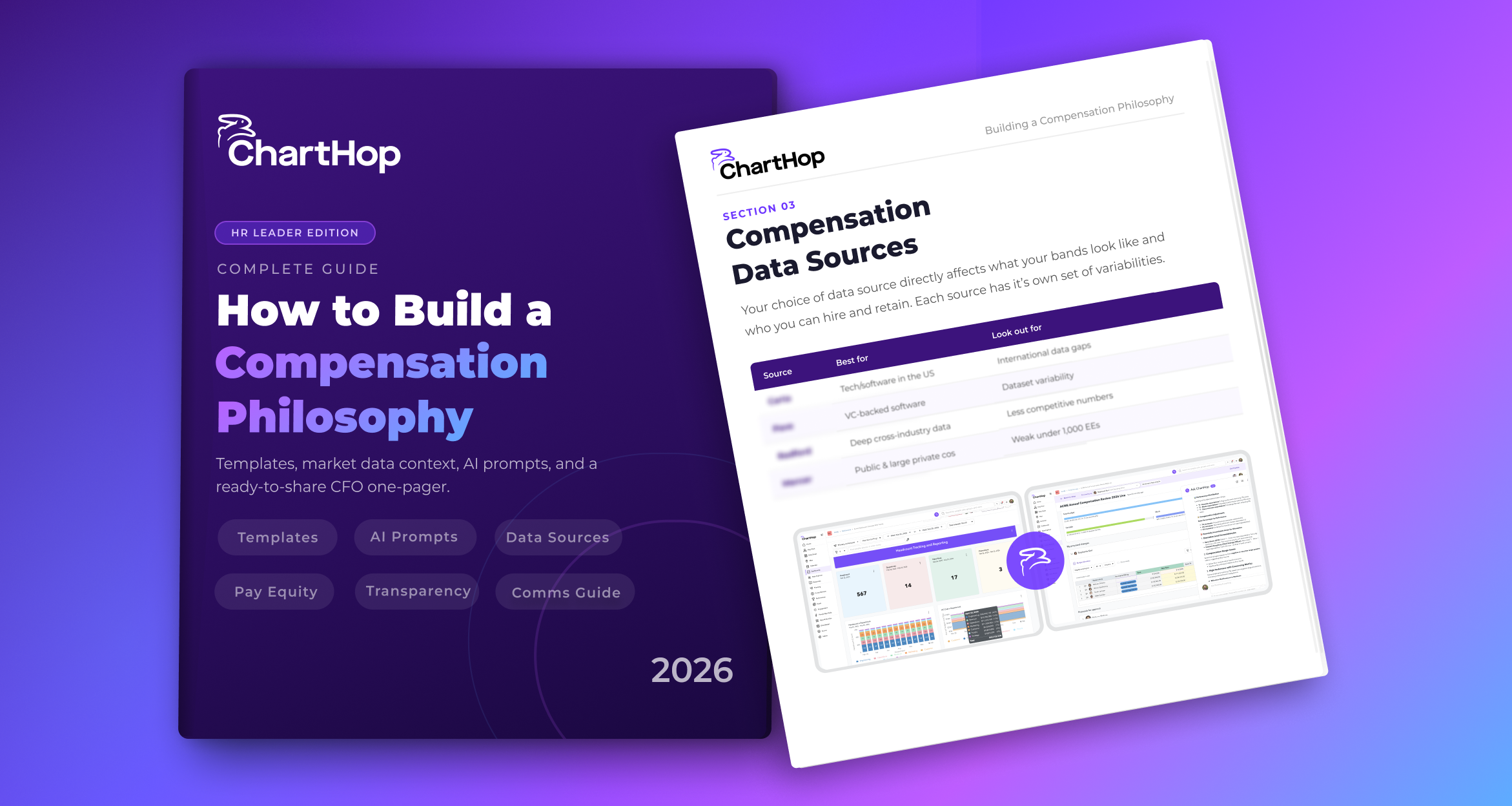
What you'll learn: What a compensation philosophy is, what goes in it, which data sources to use, how to avoid bias in promotional readiness decisions, and how to use AI to cut the drafting timeline from weeks to hours. Free guide with fill-in-the-blank templates at the end.
A compensation philosophy is a written document that defines how a company decides to pay its people. It covers the principles behind pay decisions, where the company positions against the market, which compensation data sources it uses, how total compensation components fit together, and how the company handles pay equity and exceptions.
A compensation philosophy is not a pay band spreadsheet or a salary range list. It is the strategic foundation that pay bands, review cycles, and individual compensation decisions are built on. Without one, pay decisions default to whoever negotiates hardest.
Most mid-market companies with 300 to 5,000 employees either have no written compensation philosophy or have one that is so vague it cannot actually guide a pay decision. This guide covers how to build one that can.
Without a documented compensation philosophy, three problems become common:
Whoever negotiates hardest gets the best offer. Two employees at the same level and function can end up with a $30K pay gap with no defensible explanation. Managers make exceptions to pay bands that do not exist. And when Finance asks why the last compensation review cycle ran over budget, nobody can trace the decision-making back to a documented principle.
A compensation philosophy solves this by giving everyone from a hiring manager to a CFO a shared, documented framework for pay decisions. It is also the document you point to when someone asks for an exception.
A compensation philosophy typically includes the following sections:
Most mid-market compensation philosophies are missing the geographic pay approach, the equity philosophy, the exception process, and the review cadence. These gaps are where the distance between documented philosophy and actual practice lives.
The short answer: Write two to four objectives specific enough that you could point to a real pay decision and trace it back to one of them.
"We are committed to competitive pay" is not a compensation objective. It sounds good and constrains nothing. "We target the 65th percentile of total cash for engineering roles to retain senior technical talent against FAANG-adjacent competitors" is an objective. A manager can use it to evaluate two compensation scenarios.
Start by identifying what would make your compensation program a success. Retaining senior technical talent? Competing with larger employers for a specific role type? Building a pay-for-performance culture? Closing pay equity gaps proactively? Write those down as objectives. Everything else in the philosophy flows from them.
The short answer: Name one primary source and one or two supporting sources for validation. The right primary source depends on your company stage, size, and geographic footprint.
There are four major compensation data sources most companies evaluate:
Carta is strongest for US-based technology companies. Its equity data is tied to actual cap tables, which makes its equity benchmarks more accurate than most competitors. The watch-out: its international data uses percentage-based adjustments rather than observed local market data, which reduces accuracy outside the US.
Pave has a large real-time dataset and strong equity benchmarking. A free tier is available, which makes it accessible for smaller teams. Because its dataset is still growing, its numbers tend to be less smoothed than Carta's at some role levels.
Radford (Aon) has the deepest cross-industry breadth and tends to be trusted by boards and investors. The practical trade-off: its numbers skew lower than Carta or Pave for competitive tech roles. Teams using Radford as their primary source often need to target higher percentiles to stay market-competitive.
Mercer has the most extensive global dataset and the strongest credibility for large, multi-national organizations. It is less well-suited for companies under 1,000 employees, where the cost and complexity of the platform outweigh its benefits.
A role benchmarked in Radford can come out 15 to 20 percent lower than the same role in Pave or Carta. This is not a minor technical detail. It affects what your bands look like and who you can hire and retain. Choosing your data source is a strategic decision, not an administrative one.
The short answer: Specify the percentile you are targeting, the compensation component you are measuring (base salary, total cash, or total comp including equity), and whether that varies by function or level.
A company targeting the 65th percentile of total compensation is making a very different financial commitment than one targeting the 50th percentile of base salary. The language sounds similar. The cost implications are not.
Early-stage companies (pre-product-market-fit through Series B) typically target the 50th to 65th percentile of total cash and supplement with meaningful equity. This preserves runway while remaining competitive when equity upside is credible.
Growth-stage companies competing against larger employers often need to target the 65th to 75th percentile of total cash and include equity refreshes. When a company's equity is less compelling to candidates, cash compensation has to carry more weight.
If your current philosophy says "we pay competitively" with no percentile or component specified, that is a gap. It means different people in your organization interpret "competitive" differently, and your pay decisions are only as consistent as whoever happens to be in the room.
The short answer: Most promotional readiness models include "potential" as a factor, and research shows potential ratings systematically disadvantage women in ways that performance ratings do not.
A 2023 study published in the Academy of Management Journal analyzed 29,809 employees and found that women received higher performance ratings than men but 8.3 percent lower scores for "potential." Those lower potential scores accounted for up to 50 percent of the gender promotion gap. The women who received lower potential ratings went on to outperform the men who received higher ratings.
This matters for your compensation philosophy because promotion decisions affect pay. Who gets promoted affects who reaches higher pay bands. Your philosophy should document which indicators you use to determine promotional readiness and, if potential is included, define it with specific observable criteria rather than abstract judgment calls.
There are two approaches to promotional readiness:
Lagging indicators anchor decisions to outcomes already demonstrated. The employee has been performing at the next level for a defined period. Decisions are based on what someone has shown, not what someone predicts they might do.
Leading indicators rely on assessments of potential, which is typically abstract and often evaluated against traits like assertiveness that research shows are attributed differently by gender. These assessments introduce bias that performance ratings alone do not catch.
Lagging-indicator models carry significantly lower bias risk and are easier to document and defend.
The short answer: Define how often you audit, what methodology you use, and what happens when you find a gap.
Analyze pay equity by gender and race/ethnicity across comparable roles and levels at minimum. Use compa-ratio as your primary diagnostic. Compa-ratio is an employee's salary divided by the midpoint of their pay band. If two employees in the same function and level have unexplained compa-ratio differences that cannot be accounted for by performance, tenure in level, or stage of development, that is a gap to address.
Not every pay difference is inequitable. But differences that cannot be traced to a documented, defensible reason should be corrected proactively. Corrective costs compound when gaps are discovered late. And they compound further when they become a legal or reputational issue.
Compa-ratio (short for comparative ratio) is an employee's actual salary divided by the midpoint of their pay band, expressed as a percentage. A compa-ratio of 100 percent means the employee is paid exactly at the midpoint of their band. A compa-ratio below 100 percent means they are below midpoint. Above 100 percent means they are above midpoint.
Compa-ratio is the primary diagnostic for pay equity analysis because it normalizes pay comparisons across roles with different band ranges. Two employees in the same function and level with unexplained compa-ratio differences warrant investigation.
The short answer: Use AI to draft the language once you have made the strategic decisions, then use it to stress-test the draft before it becomes policy.
AI is not useful for making the strategic decisions: where to position against the market, which data source to use, how to define promotional readiness. Those require judgment and context. AI is useful for converting rough decisions into structured prose and catching gaps before your leadership team does.
Six AI prompts that are useful for compensation philosophy work:
The stress-test prompts are where AI adds the most value. They surface the situations where your philosophy is clear in theory and ambiguous in practice.
All six prompts are copy-paste ready in the guide.
After reviewing compensation philosophies across mid-market companies, four sections are most often absent or underdeveloped:
Geographic pay approach. Distributed and hybrid workforces require a documented answer to how location affects pay. National/uniform bands use one set of ranges regardless of location, which is simpler and perceived as more equitable. Location-tiered bands use different ranges based on geographic cost-of-labor tiers, which is more cost-efficient but adds complexity and can create resentment when employees move.
Equity compensation philosophy. Your philosophy should cover grant types, timing (at hire, promotion, or annual refresh), vesting schedule, and how you communicate the value of illiquid private company equity to employees who are used to thinking about total comp in cash terms.
Exception handling process. Pay bands without a documented exception process are guidelines, not controls. The philosophy should define how band overrides are approved and tracked, because the gap between philosophy and practice almost always lives in how exceptions are handled.
When the philosophy is reviewed. Specific signals mean it is time to revisit: consistent new-hire compression, frequent manager exceptions, geographic expansion, pay equity audit patterns, or significant changes to your competitive market. The philosophy should name these signals explicitly.
How long should a compensation philosophy be?Most effective compensation philosophies run four to eight pages, organized by section with a short executive summary. Long enough to cover the decisions, short enough that a manager can find the relevant section when they need it.
Who owns the compensation philosophy?Typically the VP of People or Head of Total Rewards drafts and owns the document. The CFO or Finance team should review and co-sign it, because compensation is a budget control mechanism as much as a people strategy document.
How often should a compensation philosophy be updated?Most companies review their comp philosophy annually as part of the compensation review cycle planning process. Trigger a mid-cycle review if you see new-hire compression, consistent manager exceptions, or a significant geographic expansion.
Do you need a compensation philosophy if you use a compensation management tool?Yes. Compensation management tools like ChartHop help you run comp cycles, track compa-ratios, and give managers visibility into pay decisions. But the tool executes the decisions your philosophy defines. Without the philosophy, the tool is just tracking inconsistency at scale.
What is the difference between a compensation philosophy and pay bands?A compensation philosophy is the strategic document that defines your approach to pay. Pay bands are the specific salary ranges you set for each role and level. The philosophy informs how bands are built and how far outside them pay decisions are allowed to go. You can have bands without a philosophy. But bands without a philosophy tend to drift because there is no documented principle to anchor decisions to.
This post covers the decisions you need to make. The guide gives you the tools to document them.
What's inside the HR Leader's Guide to Building a Compensation Philosophy:
14 sections, each with a fill-in-the-blank template. A Carta vs. Pave vs. Radford vs. Mercer comparison table. Promotional readiness models with the bias research context. A pay equity audit framework using compa-ratio. Six copy-paste AI prompts for drafting, auditing, and stress-testing. A glossary of key terms. And a CFO one-pager so Finance sees your compensation philosophy as a budget control tool, not a black box.
ChartHop connects your compensation philosophy to the work of running comp cycles: comp bands, compa-ratio tracking, real-time budget visibility, pay equity analysis, and manager dashboards, all connected to your headcount plan and performance data in one place.
"Our first comp review cycle using ChartHop was an overwhelming success. I kept holding my breath waiting for something to go awry because it was going too well." Nanea Fujiyama, Director of People, Altruist


Evaluate AI HR tech vendors with confidence with these 15 critical questions that help you assess how AI is built, governed, and applied in real HR scenarios.
.png)
Seven HR and business leaders share how they actually do headcount planning. Five minutes each. One framework each. From backfills to AI scenario planning, this guide captures the key takeaways.
Take this 2-minute quiz to find out where your headcount planning process stands and get a personalized roadmap to improve accuracy, speed, and HR-Finance alignment.
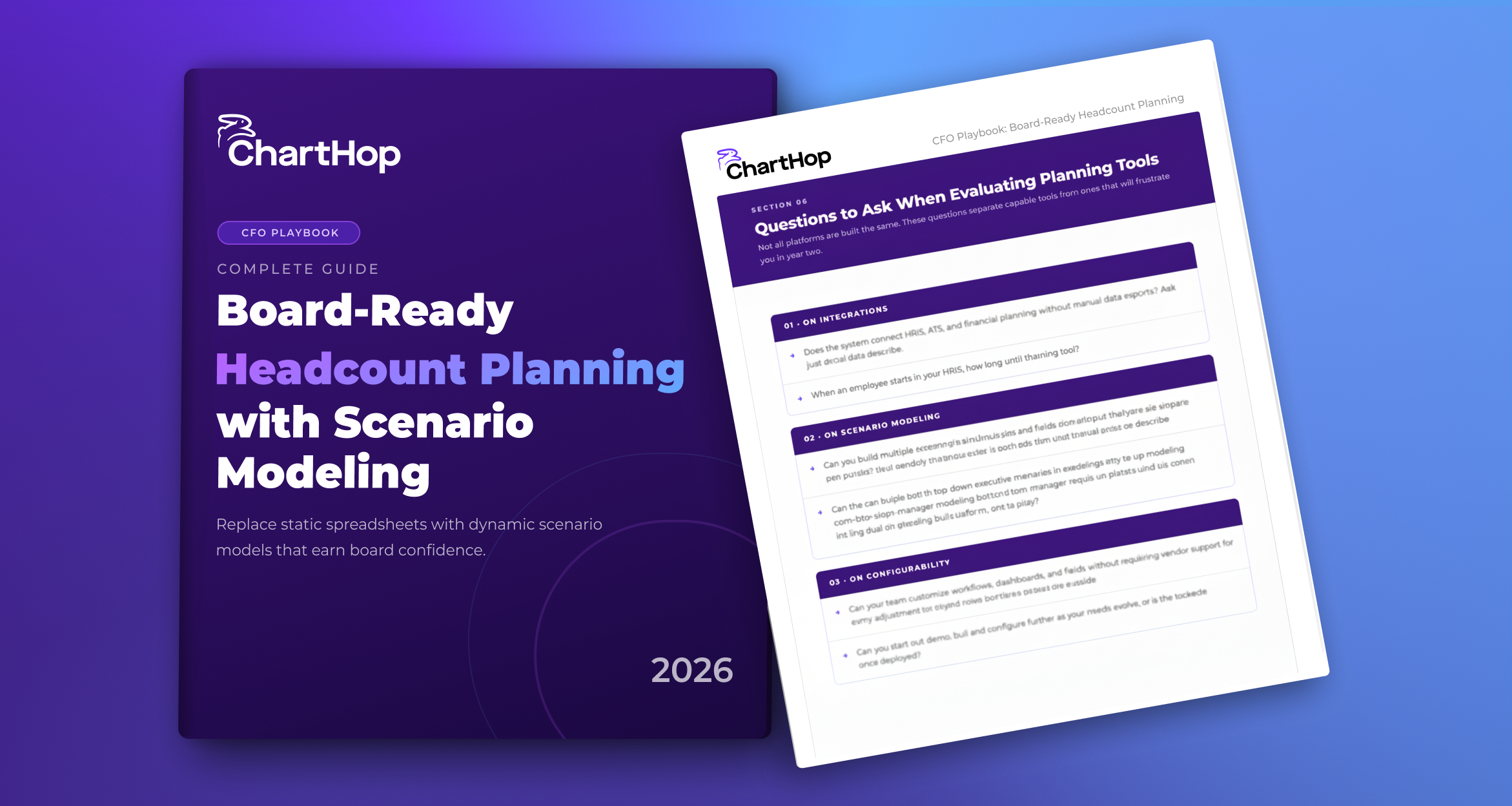
A CFO playbook for leaders who need to walk into board meetings with more than a single forecast — and leave with the board's confidence, not more questions.

See how AI-powered headcount planning helps HR and Finance teams build scenarios faster, model real-time budget impact, and make confident workforce decisions without the spreadsheets.