Workforce planning has always been a multi-dimensional problem. You’re balancing financial data, org structure, skills, location, and headcount, often across systems that don’t talk to each other. Then remote work went mainstream, AI entered the picture, and the complexity multiplied.
At Transform 2026, ChartHop CEO Ian White sat down with Michael Barrella, Recruiting Operations and Technology Manager at Airbnb, and Matt Malter Cohen, Recruiting Delivery Operations at Airbnb, to talk through how organizations are rethinking workforce planning, where AI is genuinely delivering, and why the data layer underneath everything matters more than most leaders realize.
The most obvious inflection point in workforce planning over the last few years wasn’t a software question. It was a location question: go fully remote, go hybrid, or bring everyone back, and if you stay distributed, how do you actually make it work?
Airbnb went fully remote, and that decision added a dimension to workforce planning that traditional tools weren’t built to handle. It’s not just headcount by function anymore. It’s headcount by country, time zone, and support coverage, including how you make sure a team in India gets the same level of recruiting, operations, and technology support as a team in the US. Workforce planning at this scale isn’t just financial data and org structure; it’s location, remote work, skills, and operations all layered on top of each other.
That complexity only compounds when country managers need visibility into which employees are joining their offices, but they don’t sit in a traditional top-down reporting structure. You need more than an org chart. You need a way to view and understand workforce data across matrix and cross-functional dimensions simultaneously.
The other big shift driving workforce planning today is financial scrutiny. Leaders are watching dollars more closely because the market expects efficiency, and that means they need real-time insight into decisions being made across large organizations.
At Airbnb, that pressure accelerated a move away from spreadsheets. The team implemented ChartHop to bring structure to headcount requests, build approval workflows, and make it possible to model what a headcount change actually costs before approving it.


The ability to go from macro to micro and back matters at this scale. A line manager needs a narrow view of their own team’s headcount. A department head needs to see how that rolls up. A country manager needs to understand what’s happening in their region, even if they don’t own the headcount in a traditional sense. These aren’t the same view, and they can’t all live in the same spreadsheet.
There’s a lot of AI talk at industry events right now. The more useful discussions are where it’s creating real lift and where the hype outruns reality.
The clearest answer from Airbnb’s perspective: AI has removed the tactical drag from work that used to slow leaders down. Creating charters, drafting documentation, building a deck from scattered ideas, are all examples of work that used to take hours but can now be done in minutes with AI. That frees up the people who were doing that work to focus on decisions that actually require human judgment.
But there’s a second-order effect that doesn’t get talked about enough. When the friction of prototyping disappears, the ceiling on ambition rises too.

AI didn’t just speed up the work. It expanded what’s possible.
Here’s where the conversation got most interesting. AI can do a lot, but its output is only as good as what you put into it. At organizations operating at scale, the thing that most often limits AI’s usefulness isn’t the model. It’s the data underneath it.
The risk of building proofs of concept without governance is that you end up with fragmented integrations, no shared data model, and an architecture that no one can navigate. AI agents take your data model literally. If the underlying structure is messy, the decisions it surfaces will be too.
For SaaS platforms, this is a clarifying moment. The question isn’t whether the UI is polished. It’s whether the backend infrastructure, the data structures, the permissions model, and the security layer are strong enough to support whatever users want to build on top of it. The companies that get that right will be the ones that actually deliver on the AI promise.
After watching a demo of ChartHop AI Pro, the reaction was immediate.
That kind of speed only works if the data layer underneath it is solid, which is exactly the point: the value of AI in people operations isn’t the interface. It’s what the interface is built on.
If your workforce planning is still running on spreadsheets or your data lives in too many places to act on quickly, it’s time to make a change. Discover how ChartHop brings it together, or explore our headcount planning module to see what structured, scenario-ready planning actually looks like.


Zapier’s Chief People & AI Transformation Officer explains why annual planning cycles are broken, why spreadsheets can’t keep up, and what it actually looks like to make workforce decisions in real time.

See how AI-powered headcount planning helps HR and Finance teams build scenarios faster, model real-time budget impact, and make confident workforce decisions without the spreadsheets.
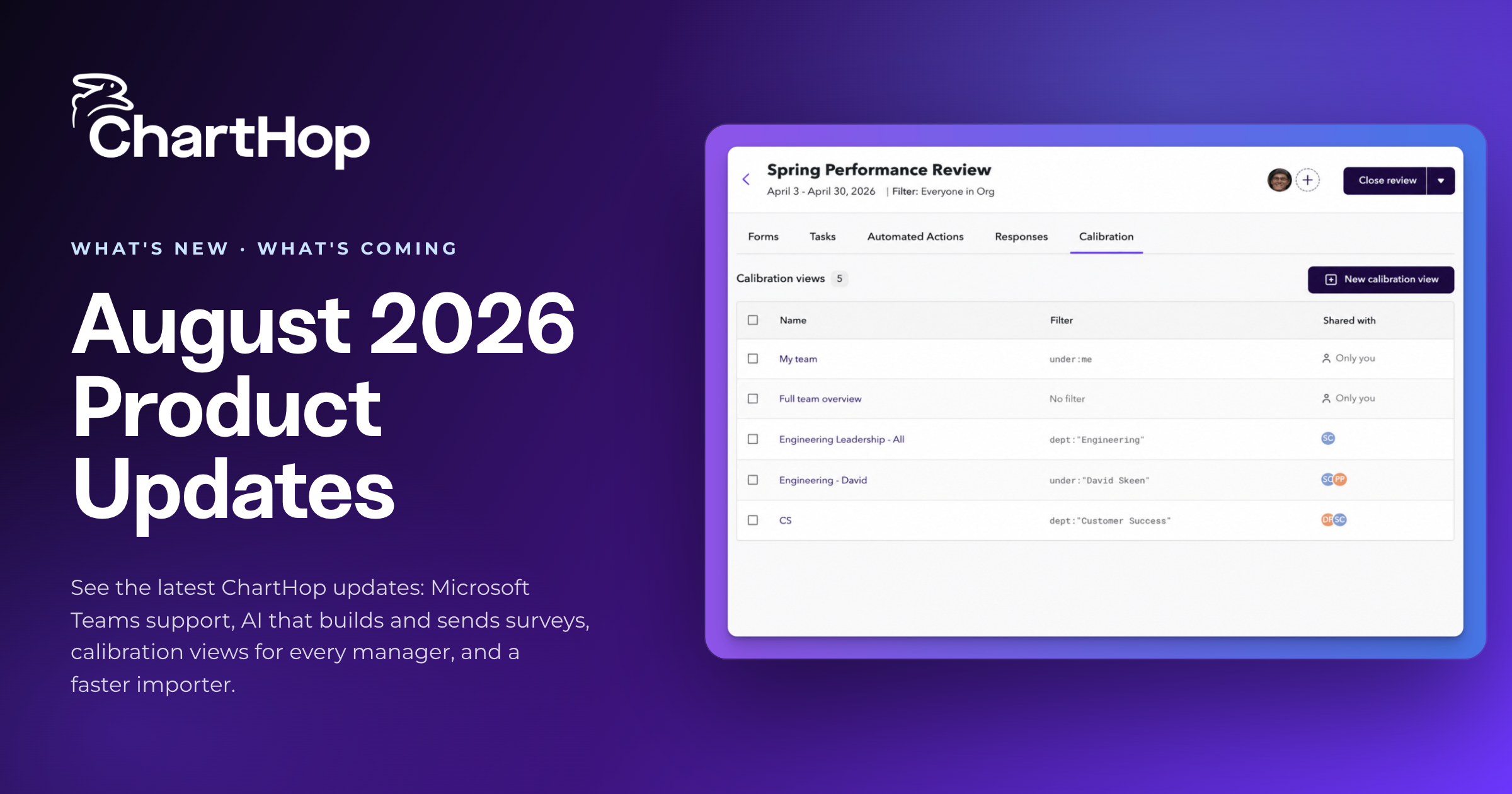
See the latest ChartHop updates for August 2026: Microsoft Teams support, AI that builds and sends surveys, calibration views for every manager, and a faster importer.

A practical playbook for putting AI agents to work in HR and people operations, from choosing the first workflow to setting guardrails and measuring results.

See how an HRIS and HCM differ, the core modules to expect, and 5 criteria mid-market teams should weigh before buying. Compare the top platforms for 2026.